 If you are planning a new driveway, patio or path, one of the first questions you will ask is how much it is going to cost. PAV1 concrete is one of the most popular choices for these jobs, but the price is not the same for everyone. It depends on a few key things. This guide breaks it down in plain terms, so you know what to expect before you get a quote.
What Is PAV1 Concrete?
PAV1 is a type of concrete made for outdoor paving. It has an additive mixed in that creates tiny air bubbles inside the concrete. These bubbles protect the surface from frost damage, so PAV1 holds up well through cold British winters. It is commonly used for driveways, patios, garden paths and light garage floors.
Because it is made for outdoor home projects rather than heavy industrial jobs, PAV1 tends to cost less than the stronger grades used for commercial work.
The Main Things That Affect PAV1 Concrete Cost
1. How Much You Need
The biggest factor in your cost is simply the volume of concrete required, measured in cubic metres. A small garden path will cost far less than a large driveway, because you are ordering less material. Getting this measurement right matters. Order too little and you will need a second delivery. Order too much with traditional methods and you pay for concrete you never use.
This is where our concrete calculator comes in handy. Enter the length, width and depth of your project area and it will work out the volume for you in seconds.
2. Access to Your Site
If a lorry can pull straight up to your project with plenty of room, delivery is usually straightforward. If you have a narrow driveway, a tight side alley or a site down a long path, this can affect the type of vehicle needed and how the concrete is delivered. Sites with difficult access sometimes need a pump or a smaller vehicle, which can add to the overall cost.
3. Delivery Distance
Like most deliveries, the further a lorry has to travel from the depot to your site, the more this can add to your final price. This is one reason it pays to use a local supplier who covers your area well.
4. How the Concrete Is Mixed
This is where the choice between traditional ready mix and volumetric concrete makes a real difference to your final bill.
With a traditional drum mixer, concrete is batched at a plant and driven to your site already mixed. You order a fixed volume, and if your job only needs 80% of that load, you still pay for the full amount. The rest either goes to waste or comes back on the lorry.
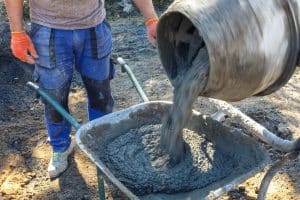
Volumetric mixers work differently. They carry the raw ingredients, cement, sand, aggregate and water, in separate compartments and mix the concrete fresh on your site as it is poured. The lorry only produces what your project actually needs. If your driveway takes 3.4 cubic metres rather than the 4 you estimated, that is exactly what you pay for. There is no waste and no guesswork.
A Simple Example Calculation
Let us say you are laying a driveway that measures 6 metres long, 3 metres wide, and needs a depth of 100mm (0.1 metres).
| Measurement | Value |
|---|---|
| Length | 6m |
| Width | 3m |
| Depth | 0.1m |
| Volume needed | 1.8m³ |
To work this out yourself: length x width x depth = volume. So 6 x 3 x 0.1 = 1.8 cubic metres.
With a volumetric mixer, you would pay for close to 1.8 cubic metres, plus a small amount extra because the ground is never perfectly flat. With a traditional drum mixer, you might need to round up to the next full load, which could mean paying for more concrete than your driveway actually needs.
This is exactly the kind of calculation our concrete calculator can do for you instantly, and our team is always happy to talk through your measurements over the phone too.
Why Volumetric Mixing Helps You Budget Better
The biggest advantage of volumetric mixing is that it removes the guesswork from your budget. You are not paying a buffer for a “just in case” amount, and you are not left with a skip full of unused concrete at the end of the day. For domestic projects like driveways and patios, where budgets are often tighter than commercial jobs, this can make a real difference to your final cost.
Planning Permission and Cost
One thing worth checking before you budget for a new driveway is whether you need planning permission. If the area you are paving is more than five square metres and the surface does not allow rainwater to drain through, you may need permission from your local council. According to the Concrete Society’s guidance on paved area restrictions, using a permeable surface or directing rainwater to a lawn or border can mean permission is not required. It is worth checking this early, as it could affect your overall project cost and timing.
Get an Accurate Quote
The best way to get an accurate cost for your PAV1 concrete project is to speak to our team directly. Give us your measurements, or use our concrete calculator, and we will talk you through exactly what your project needs and what it will cost. As a family run business established in 2002, we have been helping customers across North London, Hertfordshire, Buckinghamshire and Bedfordshire get the right amount of concrete for their projects, without the waste.
Get in touch with Base Concrete today for a quote tailored to your project.