
 Whether you are laying a shed base in your back garden or pouring foundations for a two-storey extension, choosing the right concrete grade is one of the most important decisions you will make. Get it right and your project will stand strong for decades. Get it wrong and you could face cracking, structural problems, or money wasted on a mix that is far stronger than you actually need.
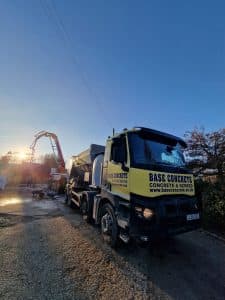
At Base Concrete, we have been supplying ready mix concrete across North London, Hertfordshire, Buckinghamshire, and Bedfordshire since 2002. In that time, we have seen every type of project imaginable. This guide brings together everything you need to know about concrete grades, from the lightest domestic mixes through to the heavy-duty options used on commercial building sites.
What Are Concrete Grades and How Do They Work?
Concrete grades tell you how strong the mix is. The number after the “C” shows the compressive strength of the concrete, measured in Newtons per square millimetre (N/mm²), after 28 days of curing. So C15 concrete can withstand 15 N/mm² of pressure, C20 can handle 20 N/mm², and so on.
The higher the number, the stronger the concrete. A higher number also means more cement in the mix, which increases the cost. That is why it is so important to match the grade to your project rather than simply picking the strongest (or cheapest) option available.
Every batch of concrete is tested to make sure it meets the required strength. For every 50 to 100 cubic metres of concrete produced, a cube sample is taken to a laboratory and crush tested to confirm it can withstand the specified Newton force.
The most common grades you will come across range from C10 right through to C40. Each one is designed for specific types of work, and choosing the right grade is not just about strength. It is about matching the concrete to the job at hand, including the loads it will carry, the weather it will face, and how long it needs to last.
C15 Concrete: The Go-To for Light Domestic Work
C15, also known as GEN 2, is one of the most commonly used grades for small residential projects. It offers a good balance of strength and workability without being overly expensive, making it a practical choice for many homeowners and DIY enthusiasts.
What Is C15 Concrete Made Of?
C15 concrete uses a typical mix ratio of 1 part cement, 2 parts fine aggregate (sand), and 4 parts coarse aggregate (crushed stone or gravel). Water is then added in careful proportions to activate the cement and bind everything together.
Getting the water content right is essential. Too much water weakens the finished concrete, whilst too little makes it difficult to work with. The aggregate ratio is equally important because the fine aggregates fill in the gaps between the coarse pieces, reducing air pockets and improving the overall density and strength of the mix.
Best Uses for C15 Concrete
C15 is ideal for lighter applications where heavy structural loads are not a concern. Common uses include:
- Shed bases and outbuildings – C15 distributes loads evenly, providing a stable platform that keeps your shed level and secure over time.
- Garden paths and patios – The mix provides enough strength for regular foot traffic whilst remaining easy to work with for a smooth finish.
- Blinding layers beneath foundations – A thin layer of C15 is often poured beneath structural foundations to create a clean, level surface for the main pour.
- Mass fill and non-structural work – Filling voids, building up levels, or any application where high structural strength is not required.
- Internal floor slabs – C15 works well for domestic floors where there is no embedded steel reinforcement.
For most small domestic projects, C15 is perfectly adequate and represents the most cost-effective option. However, it is not suitable for driveways (where vehicles will be parked), structural foundations for houses, or any application where building control requires a higher specification.
How C15 Handles British Weather
C15 concrete has moderate weather resistance. With proper curing, it can handle the typical British climate including rain, temperature changes, and mild frost. However, its lower strength compared to higher grades means it is more vulnerable to water absorption and freeze-thaw damage over time.
To get the best performance from C15 in outdoor settings, proper curing is essential. This means keeping the concrete moist for at least seven days after pouring, which allows it to reach its full strength. In cold weather, you will need to protect freshly poured C15 from freezing using insulating blankets. In hot weather, keep the surface damp to prevent it drying out too quickly, which can cause cracking.
For outdoor projects that will face heavy weathering, particularly those exposed to regular frost, you may want to consider stepping up to a stronger grade like C20 or C25 for extra durability.
C20 Concrete: The Workhorse of Residential Construction
C20 concrete, also known as GEN 3, is the most popular grade for domestic building work. It steps up the strength from C15 whilst remaining easy to work with and reasonably priced. If you are building a house extension, laying a garage floor, or creating a new driveway, C20 is very likely what you need.
Best Uses for C20 Concrete
- House foundations – C20 is the standard choice for foundations supporting lighter residential structures, including single and double-storey extensions.
- Garage floors and internal slabs – Provides the strength needed for vehicles and everyday use.
- Driveways – Suitable for light vehicle traffic, though heavily used driveways may benefit from C25 or higher.
- Shed and workshop bases – Where a stronger base than C15 is preferred.
- Oversite concrete – Used to create a solid base layer in new-build construction.
C20 offers an excellent balance between strength and cost. We supply C20 for the majority of residential projects across our coverage area, and it handles the demands of domestic construction reliably.
C20 vs C15: When to Step Up
The main reason to choose C20 over C15 is when your project needs to support greater loads or when building control requires a higher specification. Foundations for houses and extensions, garage floors, and any surface that will take vehicle traffic should all use C20 as a minimum.
C20 also provides better weather resistance than C15, making it a stronger choice for outdoor applications in the British climate. It resists frost and water ingress more effectively, which is important for maintaining structural integrity over the years.
 C25 Concrete: Extra Strength for Bigger Projects
C25 concrete provides additional strength and is commonly specified for light commercial work, heavily trafficked driveways, and foundations for larger structures. Many professionals consider it one of the most flexible grades available because it bridges the gap between domestic and commercial applications.
Best Uses for C25 Concrete
- Foundations for larger structures – Where additional load-bearing capacity is needed beyond what C20 provides.
- Heavily used driveways – If you regularly park heavier vehicles like vans or trailers, C25 gives extra confidence.
- Garden offices and large outbuildings – Provides a solid foundation for timber frames and low-rise builds.
- Light commercial work – Suitable for smaller commercial projects where C30 would be overkill.
The cost difference between C20 and C25 is relatively small, so when in doubt, upgrading to C25 provides peace of mind. Downgrading to save money can turn out to be a false economy if the concrete proves inadequate for the job.
C30, C35, and C40: High-Strength Concrete for Serious Projects
Once you move beyond C25, you are entering commercial territory. These higher grades are designed for projects where greater structural strength, enhanced durability, or specific engineering requirements demand a more robust concrete mix.
C30 Concrete: The Commercial Starting Point
C30 concrete is the standard for commercial construction and is increasingly specified for ground beams, suspended slabs, and structural elements. It is also the minimum requirement for many highway works and areas subject to heavy loading.
C35 Concrete: The Commercial Workhorse
C35 concrete has become the go-to grade for commercial construction, offering the ideal balance between structural performance and cost-effectiveness. Common applications include:
- Commercial and industrial flooring – Warehouses, factories, and retail centres where floors must withstand heavy traffic and equipment.
- External slabs and hardstandings – Parking areas and loading bays that need to endure harsh weather and heavy use.
- Agricultural structures – Silage clamps, livestock housing, and feed channels where surfaces face abrasive materials.
- Foundations for larger buildings – Where structural engineers have calculated loads that demand enhanced performance.
- Reinforced concrete frames – C35 works well with steel reinforcement, providing the bond strength needed for effective composite action.
- Driveways and ring beams – Where extra durability is essential.
C35 also includes an air-entraining admixture (AEA) when used externally, which protects the concrete from freeze-thaw damage. This is particularly important for driveways, paths, and any surface exposed to winter weather.
C40 Concrete: Maximum Strength for Heavy-Duty Applications
C40 concrete represents the upper end of commonly specified grades. It is reserved for the most demanding applications where exceptional compressive strength is essential. Uses include:
- Heavy industrial facilities – Manufacturing plants, foundries, and facilities with substantial machinery loads.
- Large-scale foundations – Supporting multi-storey buildings, steel-framed structures, or buildings on poor ground conditions.
- Infrastructure projects – Bridges, roadways, and tunnels that must endure severe conditions and heavy loads.
- Raft foundations and ring beams – Where the entire structure’s load must be distributed across a single reinforced slab.
- Agricultural buildings – Silos, barns, and containment areas that need to withstand harsh conditions. C40 also resists chemical corrosion, making it suitable for farms where slurry could damage concrete, or for septic tanks.
If your project specifies C40, the decision reflects genuine engineering requirements. These foundations are doing serious work, and the concrete must match.
 How to Choose the Right Grade for Your Project
Selecting the correct concrete grade comes down to four key questions:
What will the concrete need to support? A garden path has completely different requirements to a commercial warehouse floor. Be realistic about the loads your concrete will experience, whether that is foot traffic, occasional vehicles, or daily heavy goods vehicle movements.
What are the ground conditions? Clay soil moves more when it gets wet or dry, which may require a stronger grade or deeper foundations. Sandy soil is usually more stable. Your structural engineer will advise based on soil tests if you are working on a larger project.
Will it be exposed to the weather? Outdoor projects facing frost, rain, and temperature changes need greater durability than indoor slabs. Grades with air-entraining admixtures (like PAV1) provide extra protection against freeze-thaw cycles.
Does building control require a specific grade? For projects needing building control approval or working to structural engineer’s drawings, always stick to the specified grades. These specifications exist for good reason and should not be compromised to save money.
Quick Reference Guide
| Grade | Strength | Common Uses |
|---|---|---|
| C10 (GEN 1) | 10 N/mm² | Wall footings, conservatories, patio slabs, non-structural work |
| C15 (GEN 2) | 15 N/mm² | Shed bases, paths, blinding layers, internal floors |
| C20 (GEN 3) | 20 N/mm² | House foundations, garage floors, driveways, extension bases |
| C25 | 25 N/mm² | Larger foundations, heavy-use driveways, garden offices |
| C30 | 30 N/mm² | Commercial floors, ground beams, highway works |
| C35 | 35 N/mm² | Commercial flooring, reinforced slabs, agricultural structures |
| C40 | 40 N/mm² | Heavy industrial, infrastructure, large-scale foundations |
For most domestic DIY projects, C20 or C25 will do the job perfectly. These grades offer excellent strength without being overkill for typical residential work, and they provide the best balance of strength, workability, and value for money.
The Foundation Installation Process
Whether you are using C15 for a shed base or C40 for a commercial building, the basic process for installing concrete foundations follows the same steps.
Planning and Preparation
Before any digging starts, you need a proper plan with detailed drawings showing exactly where the foundation goes, how deep it needs to be, and what size it should be. The site gets marked out with wooden stakes and string lines, and everything is measured twice because getting this wrong means big problems later. You also need to check for underground services like gas pipes, water mains, and electricity cables.
Excavation
The digging needs to reach the formation level, which is the bottom of where your foundation will sit. The depth depends on the soil type, the size of the building, and what your structural engineer specifies. Clay soil typically means digging deeper because it moves more with moisture changes. All excavated soil needs to be removed from site or set aside for landscaping.
Formwork and Reinforcement
Formwork acts as the mould that holds the concrete in the right shape whilst it sets. For foundations, this is usually made from timber boards or steel panels. If the engineer has specified reinforcement, steel rebar or mesh gets positioned before the pour. This must be placed accurately because it provides the tensile strength that concrete alone cannot deliver.
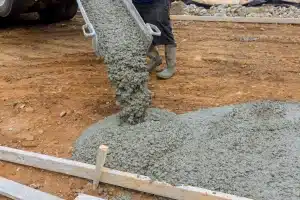
Pouring and Compacting
When the concrete arrives, it needs to be placed quickly and continuously to avoid cold joints, which are weak points where one batch of concrete has started to set before the next batch is poured against it. The concrete is then compacted using mechanical vibrators to remove air pockets and achieve maximum density.
Curing
This is the stage most people underestimate. Concrete does not just dry out; it goes through a chemical process called hydration where the cement reacts with water to form a hard, strong material. Proper curing means keeping the concrete moist and at the right temperature for at least seven days, ideally 28 days for full strength development.
In hot weather, concrete sets faster and you have a shorter working window. In cold weather, the setting process slows down and there is a risk of frost damage. Either way, the concrete needs protection during curing to reach its full potential.
Working with Concrete in Different Weather Conditions
British weather is unpredictable, and it has a big impact on how concrete behaves.
Hot Weather Challenges
In warm weather, concrete sets faster. The working window between delivery and initial set shortens, sometimes to ninety minutes or less on particularly warm days. This means everything needs to be ready before the concrete arrives, with no last-minute delays eating into your working time.
Warm concrete also loses moisture faster through evaporation. The temptation to add water to soften a seemingly stiff mix must be firmly resisted, as extra water weakens the finished concrete. Instead, retarding admixtures can be added at the batching stage to extend working time without affecting final strength.
To protect against plastic shrinkage cracking in hot weather, keep exposed surfaces damp by spraying with water or covering with wet hessian. Schedule pours for early morning when temperatures are cooler, and ensure you have enough labour on site to place and finish the concrete before it starts stiffening.
Cold Weather Challenges
Cold weather slows down the hydration process, meaning concrete takes longer to reach its full strength. If temperatures drop below freezing before the concrete has set, the water inside can freeze and expand, causing permanent damage.
To protect concrete in cold weather, use insulating blankets or heated enclosures to maintain curing temperatures. Never pour concrete onto frozen ground, and keep the concrete temperature above 5°C during the curing period. Accelerating admixtures can also help the concrete gain strength faster in cooler conditions.
Wet Weather
Avoid pouring concrete in heavy rain if possible. Rain water on the surface of freshly poured concrete dilutes the mix and weakens the top layer, leading to a dusty, flaky finish. If rain is forecast, have tarpaulins or polythene sheeting ready to cover the concrete immediately after finishing.
How Base Concrete Delivers the Right Mix for Your Project
As a family-run business based in Hemel Hempstead, we have been supplying concrete across North London and the surrounding counties since 2002. We offer several delivery options to suit different project sizes and site conditions.
Volumetric Mixers
Our volumetric lorries carry the raw materials separately and mix the concrete fresh on site to your exact specifications. The beauty of this approach is that you only pay for what you use, with virtually no waste. The mix can even be adjusted on site if needed, which is invaluable when ground conditions turn out differently from what was expected. Volumetric mixers can carry up to 10 cubic metres and are particularly popular for smaller domestic jobs where ordering a full load from a traditional mixer is not practical.
Mini Mix Lorries
Our mini mix lorries carry up to 4.5 cubic metres and are the same size as a 6-yard skip lorry. These are extremely useful when working in tighter or hard-to-reach areas where larger vehicles cannot access. We also have 8-cubic-metre lorries for bigger jobs with better access.
Concrete Pumping
When access is really tricky, our concrete pumping services solve the problem. Our line pumps mount on 7.5-tonne lorries and can run pipes up to 100 metres or more along the ground, through houses, up alleyways, or even vertically when connecting to scaffolding. For jobs that need to reach over obstacles, our 24-metre boom pump has a crane arm that can be elevated to reach over walls and up to first-floor level.
Our pumps always aim to leave your site as clean as possible, with very little waste. The operator blows a ball through the pipeline to push all remaining concrete into your site, leaving just a couple of wheelbarrows worth in the hopper.
Calculating How Much Concrete You Need
Getting your quantities right saves both money and hassle. To calculate the volume you need, multiply the length by the width by the depth of your area (all in metres) to get the total in cubic metres. For example, a 4-metre by 3-metre patio that is 100mm thick needs 1.2 cubic metres.
As a general rule, add 10% to your calculated volume for anything other than perfectly level slabs, to account for ground irregularities and spillage. For more complex pours with irregular profiles, consider adding 15%. You can use our concrete calculator for help, and our team will double-check your calculations when you call to make sure you order the right amount.
Frequently Asked Questions
Which concrete grade do I need for a driveway?
For most domestic driveways, C25 or C30 is the recommended starting point. If you park heavier vehicles like vans or trailers, C35 provides extra durability. C20 is generally not recommended for driveways, as it may not resist cracking under regular vehicle use over time. For external driveways, ask about PAV1 concrete, which includes an air-entraining admixture to protect against frost damage.
Can I use C15 concrete for foundations?
C15 is suitable for blinding layers beneath foundations and for very light structures like small shed bases. However, for house foundations, extensions, and any structural application requiring building control approval, C20 is the minimum typically specified. Always follow your structural engineer’s specification.
How long does concrete take to cure?
Concrete reaches its initial strength within about 7 days and its full design strength after 28 days of curing. However, it is strong enough for light foot traffic after about 24 to 48 hours, depending on the weather and grade. The concrete should be kept moist and protected from extremes of temperature during the curing period for best results.
Does stronger concrete always mean better concrete?
Not necessarily. Stronger mixes are harder to work with, more expensive, and may be unnecessary for your project. The best concrete is the one that matches your job’s load, use, and conditions. Going stronger than you need simply adds cost, whilst going weaker can lead to early cracking or failure.
How do I know if the ground conditions affect my concrete choice?
Clay soil moves when it gets wet or dry, which may require deeper foundations or a stronger grade. Sandy soil is usually more stable. If you are unsure about your ground conditions, a structural engineer can carry out soil tests and recommend the right approach. For projects on sulphate soils or clay, FND2 concrete with high cement content is specifically designed to resist sulphate damage.
What is the difference between a drum mixer and a volumetric mixer?
A traditional drum mixer arrives with the concrete already mixed at a batching plant. A volumetric mixer carries the raw materials separately and mixes the concrete fresh on your site. The main advantages of volumetric mixing are that you only pay for what you use, the concrete is guaranteed fresh, and the mix can be adjusted on site if your requirements change during the pour.
Get the Right Concrete for Your Project
Choosing the right concrete grade does not have to be complicated. The key is matching the strength to your project’s needs without overpaying for unnecessary performance. For most domestic projects, C20 or C25 provides the perfect balance of strength, workability, and value.
At Base Concrete, we are here to make your project successful. Call us to discuss your requirements and we will recommend the perfect concrete grade, help you calculate quantities, and arrange delivery at a time that suits your schedule. With our range of delivery options from mini-mix lorries to concrete pumps, and our commitment to leaving your site clean and tidy, you can focus on getting the job done.
Call us locally:
- Hemel Hempstead: 01442 389105
- St Albans: 01727 881979
- Watford: 01923 571221
- Luton: 01582 825545
- Aylesbury: 01296 906112