 What Is Ready Mix Concrete?
Ready mix concrete is concrete that is mixed at a batching plant before being delivered to your site, ready to pour. Rather than mixing cement, sand, gravel and water by hand or with an on-site mixer, everything is prepared in a controlled environment using precise measurements.
The ingredients are the same as any concrete mix: cement, water, aggregates (sand, gravel or crushed stone) and sometimes chemical additives. The difference is in how and where the mixing takes place. At a batching plant, computerised systems measure each ingredient to exact proportions, which means every batch comes out the same. This level of precision is very difficult to achieve when mixing by hand or on-site.
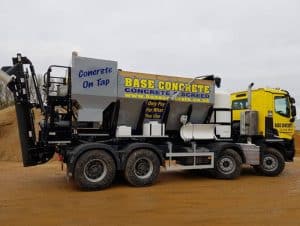
At Base Concrete, we offer ready mix concrete delivered in drum mixer lorries in two sizes: 8-cubic-metre lorries for larger jobs and our Mini Mix lorries carrying up to 4.5 cubic metres for tighter or harder-to-reach areas. We also offer volumetric mix-on-site lorries, which carry all the raw ingredients separately and mix fresh concrete right at your site. Our volumetric lorries can carry up to 10 cubic metres of materials and mix as you go, so you only pay for what you actually use.
Ready Mix Concrete vs Site Mix Concrete: What Is the Difference?
People often use the terms “concrete” and “ready mix” as though they mean different things. In reality, ready mix concrete is simply concrete that has been prepared off-site rather than mixed on location.
Here is a straightforward comparison:
Ready mix concrete is mixed at a central batching plant using automated equipment. It arrives at your site in a mixer lorry, ready to pour straight away. The mix proportions are tightly controlled, giving you consistent strength and quality every time. In the UK, ready mix concrete production is governed by British Standard BS 8500, which sets out how different concrete mixes should be specified and supplied. You can learn more about how these standards work from the Concrete Society’s guide to designated ready-mixed concrete.
Site mix concrete is mixed on-site, either by hand or using a portable mixer. You buy the raw materials separately and combine them yourself. This gives you more hands-on control, but it requires more labour, more time and more skill to get the proportions right.
For most projects, both domestic and commercial, ready mix concrete is the better choice. It saves time, reduces the risk of errors and delivers a more reliable result. Site mixing can work for very small jobs, but for anything of any real size, ready mix is the more practical and cost-effective option.
The key differences come down to:
Consistency – Ready mix is produced under controlled conditions with precise measurements. Site mix relies on manual proportioning, which can vary from batch to batch.
Time – Ready mix arrives ready to pour, so your team can get straight to work. Site mixing takes longer because you need to measure, mix and transport the concrete yourself.
Quality – Because ready mix is made in a controlled environment, the finished product tends to be stronger and more durable. Factors such as temperature and humidity can affect site-mixed concrete in ways that are hard to control.
Labour – Ready mix needs far fewer workers. With site mixing, you need people to handle raw materials, operate mixers and manage the process from start to finish.
Waste – Ready mix lets you order a precise amount for your project. With site mixing, it is harder to estimate exactly how much you need, which often leads to leftover material going to waste.
How Is Ready Mix Concrete Made?
The production process at a batching plant follows strict procedures to make sure every load meets the required standards.
First, the raw materials are stored separately. Cement is kept in sealed silos to protect it from moisture. Aggregates such as sand and gravel are sorted by size and stored in separate bays. Water is stored in clean tanks.
When an order comes in, the plant’s computerised system weighs out each ingredient according to the required mix design. The proportions of cement, aggregates, water and any additives are calculated to achieve the desired concrete grade, whether that is a standard C20 mix for a garden path or a stronger C35 mix for structural foundations.
The ingredients are then combined in a high-capacity mixer. The mixing time and speed are carefully controlled to make sure everything is blended evenly. Once mixed, the concrete is loaded into a transit mixer lorry, which keeps the drum turning during delivery to maintain the right consistency.
Concrete has a limited working life once it is mixed. It usually needs to be placed within about 90 minutes before it starts to stiffen and lose workability. That is why timing and logistics are so important, and why choosing a local supplier like Base Concrete, based in Hemel Hempstead, makes a real difference.
The Key Benefits of Ready Mix Concrete
Ready mix concrete offers a range of practical advantages that make it the preferred choice for builders, contractors and homeowners across a wide variety of projects.
Consistent quality in every batch. Because the mixing happens in a controlled environment with precise measurements, you get the same strength, durability and performance every time. There is no risk of human error affecting the proportions, and no need to worry about whether one batch is slightly different from the next. This consistency is especially important for structural work where the concrete needs to meet specific strength requirements.
Saves time on site. Ready mix concrete arrives ready to pour. There is no need to store bags of cement, no need to set up a mixer, and no waiting around while batches are prepared. Your team can focus on laying and finishing the concrete rather than mixing it. For commercial projects on tight schedules, this time saving can be significant.
Reduces labour costs. When you do not need workers mixing concrete by hand or operating on-site mixers, you can allocate your workforce to other tasks. Fewer people are needed on site, and the skilled workers you do have can focus on the work that matters most.
Less waste. Ready mix concrete allows you to order a precise quantity based on your project measurements. At Base Concrete, we work through your measurements over the phone, or you can use our concrete calculator, to work out exactly how much you need. This means less leftover material and less cost for concrete you do not use.
Improved safety. Without heavy bags of cement to lift, on-site mixers to operate, and piles of raw materials to manage, your worksite is cleaner and safer. There are fewer tripping hazards, less dust, and less heavy lifting. Workers can concentrate on their tasks without the distraction of mixing operations.
Better strength and durability. The controlled production process and precise proportions mean ready mix concrete typically achieves higher and more consistent compressive strength than site-mixed concrete. This translates into structures that last longer and need less maintenance over time. Ready mix concrete also offers excellent weather resistance, standing up well to rain, frost and temperature changes.
Versatility across different projects. Ready mix concrete can be tailored to suit almost any application. By adjusting the mix design, you can produce concrete with specific properties such as faster setting times, higher workability for complex shapes, or extra durability for exposed surfaces. Whether you need concrete for a simple shed base, a driveway, structural foundations, or a large commercial build, the right ready mix can be specified.
What Is Ready Mix Concrete Used For?
Ready mix concrete is suitable for an incredibly wide range of projects, both big and small. Here are some of the most common uses:
Domestic projects – Driveways, patios, garden paths, shed bases, garage floors, extensions, house foundations and boundary walls. For most home improvement projects involving concrete, ready mix is the simplest and most reliable option. Take a look at our domestic concrete page for more on how we help homeowners.
Commercial construction – Office buildings, warehouses, retail units, car parks and industrial facilities. Commercial projects often require large volumes of concrete with specific strength grades, which ready mix can deliver consistently. See our commercial concrete page for details.
Structural foundations – Footings, strip foundations and raft foundations for both residential and commercial buildings. The consistent strength of ready mix concrete is essential for structural work where the concrete is load-bearing.
Infrastructure – Roads, pavements, kerbing, drainage channels and retaining walls. These applications demand durable, hard-wearing concrete that can withstand heavy use and changing weather conditions.
Agricultural projects – Farmyard surfaces, silage clamps, livestock housing floors and access roads. These areas need tough concrete that can handle heavy vehicles and equipment.
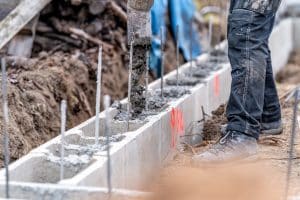
Reinforced concrete structures – When concrete needs extra strength to handle heavy loads or resist cracking, steel reinforcement bars (rebar) or mesh are placed inside the formwork before the concrete is poured. Reinforced concrete is used in columns, beams, suspended floors, retaining walls and bridges. The steel handles the tension forces that concrete alone cannot resist, while the concrete provides compressive strength and protects the steel from corrosion. For any reinforced concrete work, using ready mix is strongly recommended because the precise, consistent mix ensures a strong bond with the reinforcement and uniform strength throughout the structure.
Understanding Concrete Grades
Different projects call for different concrete grades. The grade tells you how strong the concrete will be after it has fully cured (usually measured at 28 days). Here is a simple guide to common grades:
C10 / GEN1 – A general-purpose mix used for non-structural work such as blinding, drainage bedding and filling trenches.
C15 / GEN2 – Suitable for floor blinding, domestic floor slabs and light foundations where loads are minimal.
C20 / GEN3 – A popular choice for domestic foundations, internal floor slabs, driveways and general groundwork. A good all-round grade for most residential projects.
C25 – Used for domestic and light commercial foundations, reinforced floor slabs and pathways. Slightly stronger than C20, it provides a bit more durability.
C30 – A stronger mix suitable for reinforced foundations, external slabs and hardstanding areas. Often used where the concrete will be exposed to heavier loads or more demanding conditions.
C35 – Used for commercial foundations, structural beams and heavy-duty applications. This grade provides significant compressive strength for load-bearing structures.
C40 – A high-strength mix for commercial and industrial use, including heavily loaded structural elements and pre-stressed concrete.
At Base Concrete, we can supply any of these grades to suit your project requirements. If you are not sure which grade you need, our team will be happy to advise based on your project details.
Ready Mix Concrete for Commercial Projects
Commercial construction projects have specific demands that ready mix concrete is perfectly suited to meet. Whether you are building a new office block, expanding a warehouse, or laying the floor of a retail unit, here is why ready mix makes sense:
Large volumes delivered on schedule. Commercial projects often need substantial quantities of concrete poured within tight timeframes. Ready mix can be delivered in the volumes you need, precisely when you need it, so your programme stays on track.
Meets structural specifications. Architects and structural engineers specify particular concrete grades and properties for commercial buildings. Ready mix concrete can be designed to meet these specifications exactly, with test certificates to prove compliance.
Reduces on-site disruption. On a busy commercial site, the last thing you need is workers mixing concrete in the middle of other operations. Ready mix keeps the site cleaner and lets different trades work alongside each other more efficiently.
Works well with concrete pumping. For multi-storey buildings, confined sites or hard-to-reach areas, our concrete pumps can place ready mix exactly where it is needed. Our line pumps can run pipes up to 100 metres, and our 24-metre boom pump can reach over and around obstacles with its crane arm.
Ready Mix Concrete for Residential Projects
Home improvement projects benefit just as much from ready mix concrete. Even if you only need a small amount, the advantages of quality, convenience and reliability still apply.
For smaller domestic jobs, our Mini Mix lorries are ideal. These carry up to 4.5 cubic metres and are roughly the same size as a skip lorry, so they can access tighter streets and smaller driveways where full-size trucks cannot go.
Our volumetric lorries are another excellent option for domestic work. Because they mix fresh concrete on site, you only pay for what you use. If your job turns out to need slightly more or less than expected, there is no waste and no additional cost.
Common residential projects that benefit from ready mix include shed bases, driveways, patio slabs, garden paths, extension foundations, garage floors and boundary walls. Whatever the size of your project, our team can help you work out exactly how much concrete you need and which grade is right for the job.
How Ready Mix Concrete Reduces Waste
One of the most practical advantages of using ready mix concrete is how much it reduces waste compared to mixing on site.
When you mix concrete yourself, estimating the exact quantity you need is difficult. Most people end up making too much, leaving leftover material that has to be disposed of. Over-ordering raw materials also means bags of unused cement and piles of excess aggregate cluttering up your site.
Ready mix concrete solves this problem by delivering a precise amount based on your project measurements. At Base Concrete, we work through your measurements with you to calculate the exact cubic metreage needed. This means you order only what your project requires.
With our volumetric lorries, waste reduction goes even further. Because the concrete is mixed on site from separate ingredients, you use exactly the amount you need and nothing more. If you need 3.7 cubic metres, that is exactly what gets mixed. There is no leftover concrete to deal with.
This precision has real financial benefits too. You are not paying for concrete you do not use, and you avoid the cost of disposing of surplus material. For larger projects, these savings can add up quickly.
The Environmental Benefits of Ready Mix Concrete
Ready mix concrete offers several environmental advantages over traditional on-site mixing methods. The British Ready-Mixed Concrete Association (BRMCA) highlights that the industry continues to improve its environmental performance through better resource efficiency and reduced waste.
Less material waste. The precision of ready mix concrete means less surplus material ends up being thrown away. Reduced waste means fewer resources consumed and less material going to landfill.
Lower carbon emissions from transport. Because ready mix is produced at a central batching plant, raw materials are transported in bulk to one location rather than being delivered separately to multiple construction sites. This reduces the total number of vehicle journeys and lowers the associated carbon emissions. Choosing a local supplier further reduces the environmental impact of transport.
More efficient use of energy. Modern batching plants use advanced equipment and automated processes that are more energy-efficient than the small-scale mixers used for on-site mixing. The centralised production process also means less energy is wasted on repeated setups and clean-ups at individual sites.
Recycled materials. Ready mix concrete production can incorporate recycled materials such as fly ash and ground granulated blast-furnace slag (GGBS) as partial replacements for cement. This reduces the demand for virgin materials and makes use of industrial by-products that would otherwise go to waste.
Longer-lasting structures. Because ready mix concrete produces stronger, more durable structures, buildings and surfaces last longer before they need repair or replacement. This means fewer raw materials are consumed over the lifetime of a structure.
Concrete Pumping: Getting Ready Mix Where It Needs to Go
Sometimes the challenge is not the concrete itself but getting it to where it needs to be poured. That is where concrete pumping comes in. At Base Concrete, we offer two types of pump to suit different situations.
Line pumps use steel and rubber pipes laid along the ground to transport concrete from the lorry to the pour point. Our line pumps are mounted on 7.5-tonne lorries, so they are not especially large, but they can run pipes up to 100 metres or more in length. They are perfect for reaching through houses, up alleyways, or even vertically when connected to scaffolding. Each pump carries 60 metres of pipeline, so for longer runs we carry out a site visit first to work out how much pipe is needed.
Boom pumps have a crane-like arm that can be raised and extended to reach over and around obstacles. Our 24-metre boom pump is ideal for pouring walls, reaching over existing structures, and pumping to upper floors of buildings. Boom pumps are extremely useful in harder-to-reach areas where line pumps might struggle to get past obstructions.
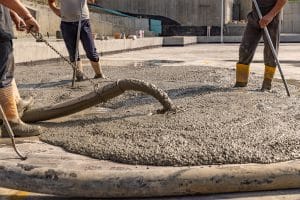
Concrete pumping is becoming increasingly popular because it can solve access problems and save on labour costs. Instead of wheeling concrete across a site in barrows, the pump places it exactly where it is needed with very little mess or waste. Our pump operators make sure that all the concrete in the pipeline is pushed through to your site using an air-pressure ball system, so there is almost no wasted material.
Floor Screed: A Ready Mix Solution for Smooth Finishes
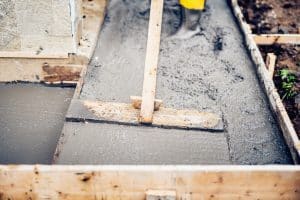
For projects that need a smooth, level floor surface, we also supply floor screed. Screed is a finer mix than standard concrete, made with cement and sharp sand rather than coarse aggregates. It is laid on top of a concrete base to create a flat, even surface suitable for floor coverings such as tiles, carpet or laminate.
Floor screed is an excellent choice for covering underfloor heating systems, as its smooth consistency allows it to encapsulate the heating pipes evenly and conduct heat efficiently. It is also widely used in large commercial and industrial spaces such as warehouses, workshops and retail units.
We supply floor screed in both large and small quantities, and our smaller lorries and pumps can handle sites with difficult access. We have worked closely with homeowners, developers, architects and construction companies throughout our service area.
Why Choose Base Concrete?
Base Concrete is a family-run business based in Hemel Hempstead, established in 2002. We deliver ready mix concrete to both domestic and trade customers across North London, Hertfordshire, Buckinghamshire and Bedfordshire.
Here is what sets us apart:
We are a family business that cares. We pride ourselves on having helpful and friendly staff who take the time to understand your project and advise you on the right product. We are not a faceless corporation; we are real people who want your project to go well.
We leave your site clean and tidy. This is something you do not always find in our industry, but it matters to us. We treat your property with respect and make sure we leave it as we found it.
We have the right lorry for every job. From our Mini Mix lorries for tight access to our 8-cubic-metre trucks for larger pours, and our volumetric lorries that mix fresh concrete on site, we have the flexibility to handle any project.
Concrete pumping for difficult access. Our line pumps and 24-metre boom pump mean we can get concrete to places that would otherwise be impossible or extremely labour-intensive to reach.
We know concrete. With over 20 years of experience, we have supplied concrete for thousands of projects of every size and type. We will guide you through choosing the right grade, calculating the right quantity, and scheduling your delivery.
Frequently Asked Questions
What is the difference between concrete and ready mix concrete? Ready mix concrete is simply concrete that has been mixed at a batching plant before delivery, rather than being mixed on site. The ingredients are the same – cement, water and aggregates – but the controlled factory mixing produces a more consistent and reliable product.
How much ready mix concrete do I need? This depends on the size and depth of your project. You can work out the volume in cubic metres by multiplying the length, width and depth of the area to be filled. Give us a call and we will go through your measurements with you.
What grade of concrete do I need? The right grade depends on your project. For general domestic use such as shed bases and paths, C20 is usually suitable. For driveways and domestic foundations, C25 or C30 is more appropriate. For structural and commercial work, C35 or above may be required. If you are not sure, get in touch and we can advise.
How long does ready mix concrete take to set? Concrete starts to harden within one to two hours of mixing, depending on the weather. It reaches working strength within a few days, but full curing takes approximately 28 days. During this time, it is important to keep the concrete moist, especially in hot or windy conditions, to help it reach its full strength.
Can you deliver ready mix concrete to small residential jobs? Absolutely. Our Mini Mix lorries carry up to 4.5 cubic metres and can access streets and driveways that larger trucks cannot reach. Our volumetric lorries are also ideal for smaller jobs because you only pay for what you use.
What is a volumetric lorry? A volumetric lorry carries all the raw concrete ingredients separately and mixes them fresh on your site using computerised controls. This means the concrete is as fresh as possible, you only pay for what is poured, and the mix can be adjusted on the spot if needed. Our volumetric lorries can carry up to 10 cubic metres of materials.
Do you offer concrete pumping? Yes. We have line pumps that run pipes along the ground for up to 100 metres, and a 24-metre boom pump with a crane arm for reaching over and around obstacles. Pumping is ideal for sites with difficult access or where you want to reduce manual handling.
Where do you deliver? We are based in Hemel Hempstead and deliver across North London, Hertfordshire, Buckinghamshire and Bedfordshire. Our service areas include Watford, St Albans, Luton, Stevenage, Welwyn, Aylesbury and many surrounding towns. Check our areas we cover page or give us a call to confirm we cover your location.
Get in Touch
Ready to order ready mix concrete for your next project? Our friendly team is here to help.
- Hemel Hempstead: 01442 389105
- St Albans: 01727 881979
- Watford: 01923 571221
- Luton: 01582 825545
- Aylesbury: 01296 906112
We will help you choose the right concrete grade, calculate the quantity you need, and schedule your delivery at a time that works for your project. Contact us to get started.