Managing a build in London means dealing with narrow streets, restricted access, neighbouring properties on all sides, and tight delivery windows. Getting concrete to where it needs to go is rarely straightforward. That is why concrete pumping has become a go-to choice for commercial projects across the capital.
This article explains how pumping works on a commercial site, why it suits London’s conditions, and how pairing it with the right commercial concrete mix makes the whole process faster and more cost-effective.
The Problem with Delivering Concrete in London
On most commercial sites outside a city, a lorry can pull up close to the pour area and discharge directly. In London, that is rarely possible. Streets are often too narrow, neighbouring buildings sit right up against the boundary, and ground-floor access may be blocked by scaffolding or hoardings.
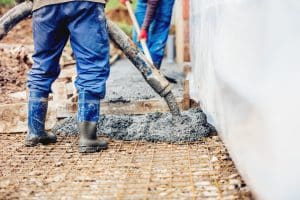
Concrete pumping solves this. It moves concrete from the lorry to the pour point through a system of pipes, without needing the vehicle itself positioned right next to the work. It also solves the problem of pouring at height — a lorry cannot tip into a first-floor ring beam or suspended slab, but a pump can reach it easily.
Line Pumps vs Boom Pumps
There are two main types used on commercial sites.
| Pump Type | How It Works | Best For | Reach |
|---|---|---|---|
| Line pump | Pipes run along the ground using steel and rubber sections | Tight alleyways, through buildings, up scaffolding | Over 100 metres |
| 24m boom pump | A crane arm elevates and directs concrete from above | Pouring walls, bases behind obstructions, up to first-floor level | Up to 24 metres |
A line pump is mounted on a compact 7.5 tonne lorry. Pipes connect together and run from the lorry to the pour point, going around corners, through gaps, and up vertically against scaffolding. Each lorry carries 60 metres of pipeline as standard.
A boom pump has a crane arm that extends over and around obstacles, making it ideal when you need to pour over a wall or reach the first floor. According to the Concrete Society, mobile boom pumps are widely used on commercial sites in crowded city areas precisely because of this flexibility.
Why Pumping Works for Commercial Concrete
Beyond solving access issues, pumping brings practical benefits on any commercial programme.
Speed. Pumps deliver around one cubic metre of concrete per minute — far faster than manual methods. On time-sensitive London contracts, this is a real advantage.
Less labour. Concrete flows directly to the pour point. The crew focuses on placing and finishing rather than moving material.
Cleaner sites. Concrete travels through enclosed pipes rather than being shovelled across the ground. Less spillage, less mess at neighbouring boundaries, and a more professional operation overall.
Choosing the Right Mix for Pumping
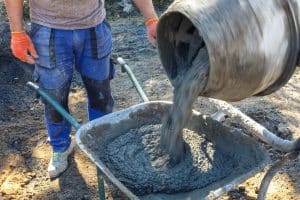
The concrete needs to be workable enough to flow through the pipeline without segregating. For most commercial work this means using a volumetric concrete mix — batched fresh on site in the exact quantity needed, so you only pay for what you use.
The grades most commonly used with pumping on commercial projects are:
- C35 — for industrial floors, raft foundations, and heavy-duty external applications. See C35 concrete London.
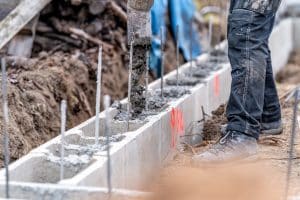
- C40 — for large structural pours, ring beams, and high-specification foundations. See C40 concrete London.
For simpler ground-level pours with easy access, ready mix concrete delivered by volumetric lorry may be all you need. But for the access and programme challenges typical of London commercial sites, adding a pump gives you control, speed, and a cleaner result.
Get a Quote
Base Concrete supplies commercial concrete and pumping services across North London and Hertfordshire. Call 01442 389105 or get in touch via our contact page to discuss your project.